
Store build & setup
What's included
- Shopify or WooCommerce
- Product & variant structure
- Payment gateway
- Shipping & COD logic
- Checkout optimisation
06 · E-commerce & D2C growth
Store, catalogue, creative, marketplaces and the paid engine that moves units — set up together, by one team, so the ad and the product page finally make the same promise.
Live client store · WooCommerce · full catalogue creative
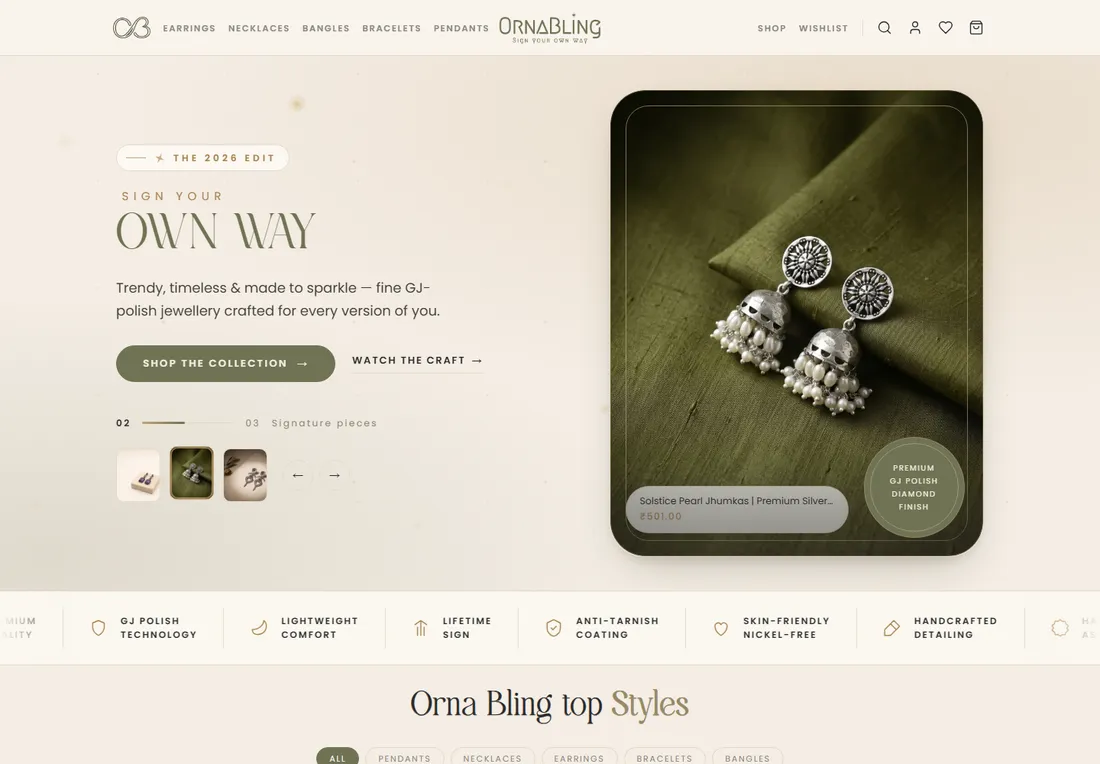
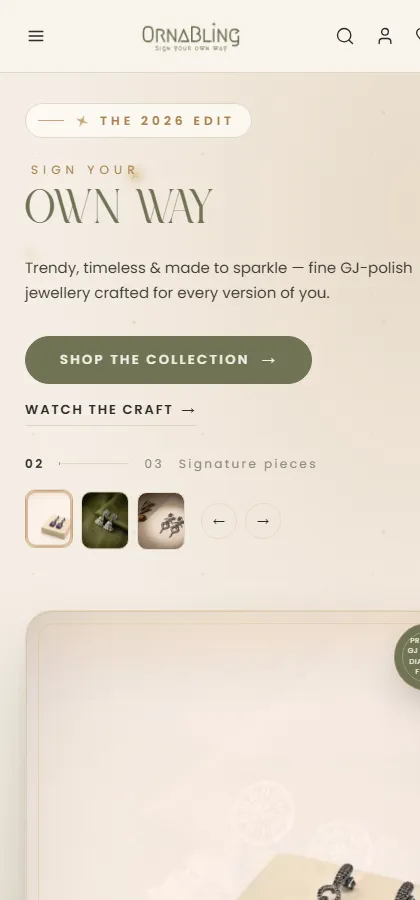
It is an argument for spending money, made once per product, at the moment someone is deciding. Most stores publish the catalogue and forget to make the argument.
Add to cart
What the page is for
Every element earns its place by moving someone toward the button
Per SKU
Creative that scales
A catalogue where every product carries the brand, not a packshot on white
Store + market
Both channels
Your own site and the marketplaces, run so they do not cannibalise each other
Second order
Where profit lives
Post-purchase flows, because the first sale rarely pays for the acquisition
Before you scale
Rarely the product. Almost always one of these five, and usually more than one at once.
Traffic hits a page that does not answer size, delivery, returns or trust, and the budget buys expensive proof that the page is broken.
A catalogue of packshots on white tells a buyer what the thing is, never why it is worth ₹1,399 rather than ₹499.
Amazon and Flipkart rent you a customer. You never learn their email, so every sale starts from zero again.
Acquisition cost is paid on order one. Brands that never build repeat purchase are permanently buying their revenue.
Store from one, creative from another, ads from a third. The product page and the ad end up making different promises.
Anatomy
This is a real page from a store we built. Seven things are doing work here, and a default theme gives you two of them.
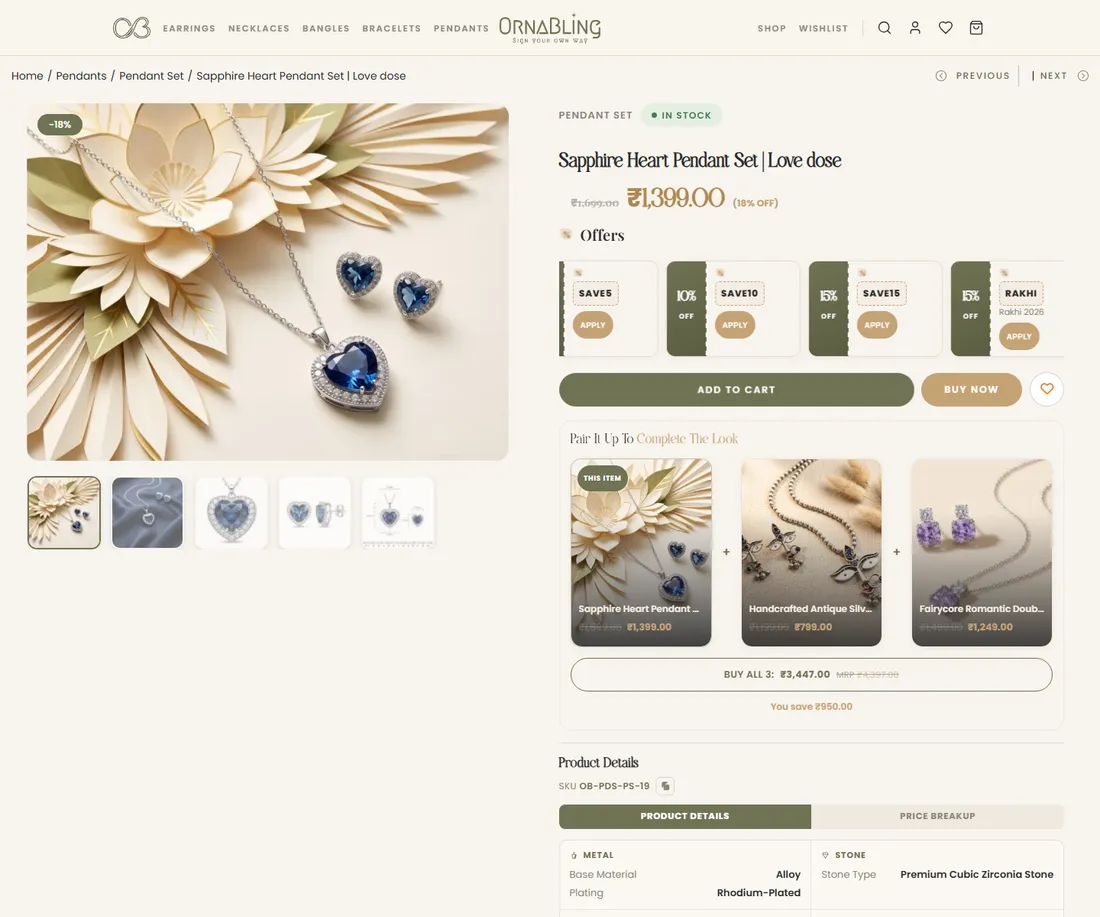
Strike-through, discount badge and savings shown together, so the number reads as a decision rather than a demand.
In-stock status and the category chip answer two silent questions before the buyer has to scroll.
Coupons surfaced on the page instead of hidden at checkout — where they rescue a hesitating buyer, not just discount a decided one.
Add to cart for browsers, buy now for the decided. Forcing both through one path costs you one of them.
"Complete the look" with combined pricing and the saving stated. The cheapest increase in order value available.
Metal, plating, stone, SKU. For considered purchases the spec table removes the last reason not to buy.
Worn, in context and close up — because scale and drape are what a photograph has to communicate.
What we build
Buy the pieces you are missing. The reason to buy several is that the handoffs between them — catalogue to creative, creative to ads, ads to page — are where D2C usually breaks.
What's included
What's included
What's included
What's included
What's included
What's included
Marketplaces
Listing the same catalogue everywhere is how brands end up busy and unprofitable. We pick the two or three where your category actually indexes.
Our work
Ornabling — a live WooCommerce jewellery store, with the per-product creative pipeline that keeps every SKU looking like the same brand.
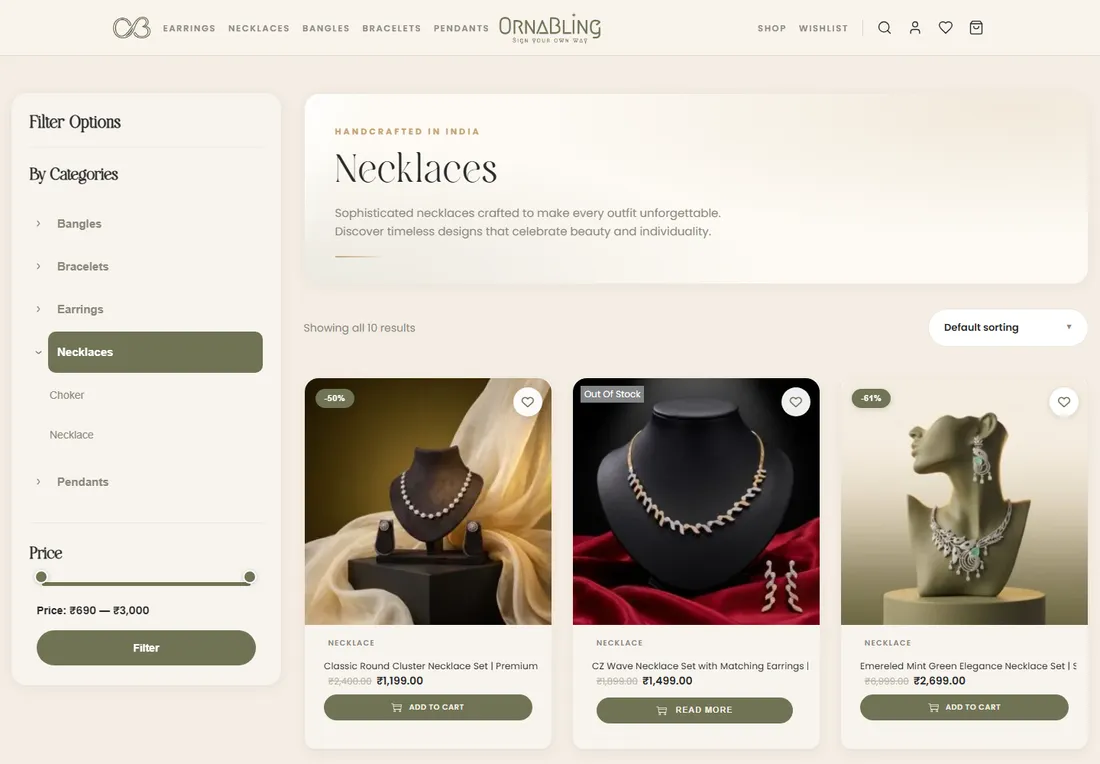






Live store, real catalogue, real creative pipeline. We describe what was built rather than quote a revenue figure, because no campaign result has been measured over a window long enough to mean anything yet — see the full case study.
How we work
If the margin does not survive shipping, returns and acquisition cost, scaling makes the problem bigger. So that is step one, before anything is designed.
Margin per unit, shipping and return cost, repeat rate. Growth plans built without these numbers scale a loss.
Collections, variants, filters and category pages designed around how people actually shop your products.
Per-SKU sets that carry the brand — lifestyle, on-model and detail, sized for store, ads and marketplace.
Fast pages, clean checkout, tracking wired, and product pages built with the anatomy above rather than a theme default.
Catalogue and dynamic ads on controlled spend, with retargeting sequenced by how far someone got.
Post-purchase flows, review requests and win-back, so acquisition cost is amortised across a customer rather than a transaction.
Proof
Public Upwork profile - every contract, rating and comment, including the platform's own reliability score.
5.0
Average rating
100%
Job success
27
Jobs delivered
0-4 hrs
Response time
Freelance contracts on Upwork under the founder's profile, not agency client counts. Verified 2026-08-30.
Client success stories
Copied verbatim from completed contracts. Every quote is on the public profile if you want to check it.
One of the best editors I've worked with. He understands storytelling, pacing, and audience retention really well. Highly Recommended.
Excellent experience, only way to describe Ashish services is he goes above and beyond. Excellent attention to detail, he's a project partner and asset.
Ashish is a great freelancer to work with. He is timely, professional, takes feedback and implements it very well and also gives good suggestions on helping us meet our goals for the videos that we talk about. He has a good skill set and we will be using him moving forward.
Ashish completed a small project for me and delivered quality work. He was communicative and met his deadlines, which is highly appreciated. You should consider working with him.
Traits clients selected when endorsing the work
Questions
D2C enablement is building everything a brand needs to sell directly to customers rather than only through resellers — the online store, product catalogue and creative, the paid acquisition engine, and the retention flows that earn a second order. The point is that these are built to work together, because a store that converts badly makes good ads expensive and good ads make a bad store obvious.
Shopify if you want the platform maintained for you and your catalogue is reasonably standard; the monthly cost buys you not thinking about hosting, security or checkout. WooCommerce if you need unusual product logic, deep content and SEO alongside the store, or want to avoid platform fees at scale. We have built and run both, and the honest answer usually depends on who maintains it after launch.
Both, deliberately. Marketplaces give you volume and buyer intent but rent you the customer — you never own the relationship or the data. Your own store is where margin and repeat purchase live, but you pay for every visit. The usual answer is marketplaces for discovery and cash flow, your own site for the customers worth keeping.
For considered purchases like jewellery or apparel, five to seven: a clean primary, a scale reference, at least one worn or in-use, a detail crop, and one lifestyle frame. We produce these as a repeatable set so adding a product means running it through a pipeline rather than briefing a shoot each time.
We direct and produce product creative, including AI-assisted and lifestyle treatments where a full studio day is not justified. The Ornabling catalogue on this page was produced that way — a repeatable per-product pipeline rather than a shoot per SKU, which is what makes the cost per product sustainable.
Indian D2C stores commonly sit between 1% and 2.5%, with well-built ones reaching higher on branded or returning traffic. Be sceptical of anyone quoting a target before seeing your product, price point and traffic source — a 3% conversion rate on branded search and on cold Meta traffic are not the same achievement.
Usually, and it is usually cheaper. Most stores we look at do not need a rebuild — they need the product page restructured, the checkout shortened, the images redone and tracking fixed. We will tell you which situation you are in during the audit, including when the honest answer is that the platform has to change.
A focused store with a modest catalogue is typically four to six weeks including creative production. Larger catalogues and marketplace setup extend that. The variable is almost always product data and imagery — the build waits on the catalogue far more often than the catalogue waits on the build.
Start here
We will go through it as a buyer would — product page, checkout, mobile speed, imagery — and tell you the three changes most likely to move your conversion rate before you spend another rupee on traffic.
Prefer to talk? +91 98518 62131 or WhatsApp.
E-commerce enquiry